Family holiday. One camera, one lens, a solar filter, and about sixty-seven minutes of the Moon walking across the Sun while everybody else on the terrace got increasingly excited about the light going strange.
All times are Menorca local (CEST, UTC+2), with UK time (BST, UTC+1) in brackets. The camera clock was still on UK time, which is why the raw files read an hour behind the local wall clock.
Nothing exotic. A Sony A7 III with the 24-240mm at the long end, on a tripod, with a solar filter over the front for everything except totality. No tracking mount, no guiding: just a tripod and the discipline to nudge it back every few minutes as the Sun walked out of frame.
The camera fired a five-shot bracket every fifteen seconds for the whole event. That is 1,353 raw frames and about 63 GB. Through the filter the partial phases ran at f/8, ISO 400, from 1/125 to 1/2000. When the filter came off at second contact the brackets moved to f/6.3, ISO 800, spanning a full second down to 1/250, because nobody knows in advance how bright a corona through thin cloud is going to be, and the only honest answer is to bracket wide and sort it out later.
First contact at 19:27 local/CEST (18:27 UK BST). The Moon takes its time: nearly an hour of watching a notch turn into a bite turn into a crescent, with the light going gradually wrong in a way that is difficult to photograph and impossible to forget. Half the disc was gone by 19:57, three quarters by 20:06, and by 20:11 there was 85% of the Sun missing and the sky was visibly draining.
Then cloud. Of course there was cloud: a bank of it rolling in from the horizon in the last ten minutes before totality, exactly where the Sun was heading. There is a particular flavour of despair reserved for watching that happen with a camera already running.
Totality at 20:18:49 local/CEST (19:18:49 UK BST), and the cloud turned out to be a gift.
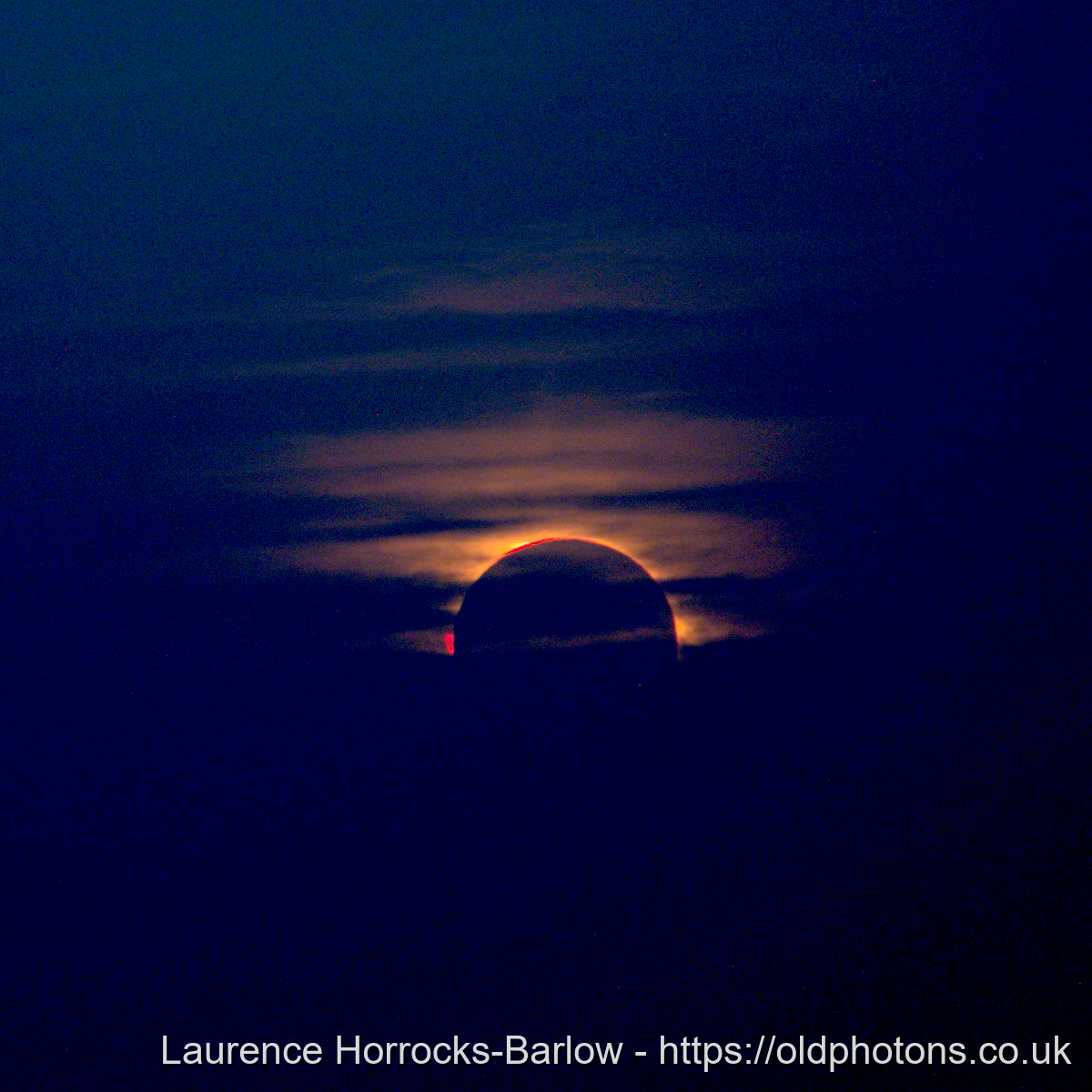
It thinned to almost nothing right at second contact, and what came through was not the hard black disc and silver corona of a clear-sky eclipse. It was softer: the dark Moon sitting in a deep blue twilight, a warm arc of light around the limb, and, clearly visible on the lower left, red prominences, loops of hydrogen standing off the solar edge. All of it seen through a gauze of high cloud that lit up around it.
Sixty-five seconds. Third contact at 20:19:50 local/CEST (19:19:50 UK BST), and the diamond ring came back through a sky that had turned orange, because by then the Sun was low enough to be setting into the haze as well as emerging from eclipse.
The receding partial phases ran until 20:33 local/CEST (19:33 UK BST), when the last thin sliver disappeared into the horizon murk still partially eclipsed. The Sun set before the Moon finished with it.
Each of the 269 bracket sets was merged into a single high-dynamic-range frame in linear space, weighted away from clipped highlights, then tone mapped. That matters more than it sounds: the Sun’s brightness falls by a factor of thirty across this sequence, and a fixed exposure would either blow out the start or lose the end entirely.
The Sun was then located in every single frame and the crop centred on it, so the disc sits still while the Moon moves across it. Without that the sequence is unwatchable, because the Sun drifts across the frame and jumps every time the tripod was nudged, sixteen times in total, once by nearly 3,700 pixels.
Two things nearly cost me the end of the sequence, and both are worth writing down:
The obvious detection is the wrong detection. Finding “the brightest thing in the frame” works beautifully until totality, when the Sun becomes the darkest thing in the frame: a black disc with a bright rim. Every brightness metric said the Sun had gone behind cloud. It had not. It had gone dark, which is the entire point of the exercise.
A thin crescent looks exactly like sensor noise. Late in the sequence the lit crescent is only a few hundred pixels against a noisy sky, and a pixel-by-pixel threshold cannot tell the two apart. Blurring the frame slightly before looking fixes it: real structure survives a blur, single hot pixels do not.
The photographs here are stills from that sequence, and the videos are the whole thing at twelve frames per second, about sixty-seven minutes of sky in twenty-two seconds.
A tracking mount, obviously. Sixteen manual re-centres is sixteen chances to knock the framing, and I used all of them.
Beyond that: no. The cloud that looked like a disaster made the totality frames far more interesting than a clean sky would have. A black disc against black sky is a technical achievement. A dark Moon with prominences hanging in blue twilight behind a veil of cloud, with the family making a great deal of noise somewhere off to the left, is a photograph of an afternoon.
Comments