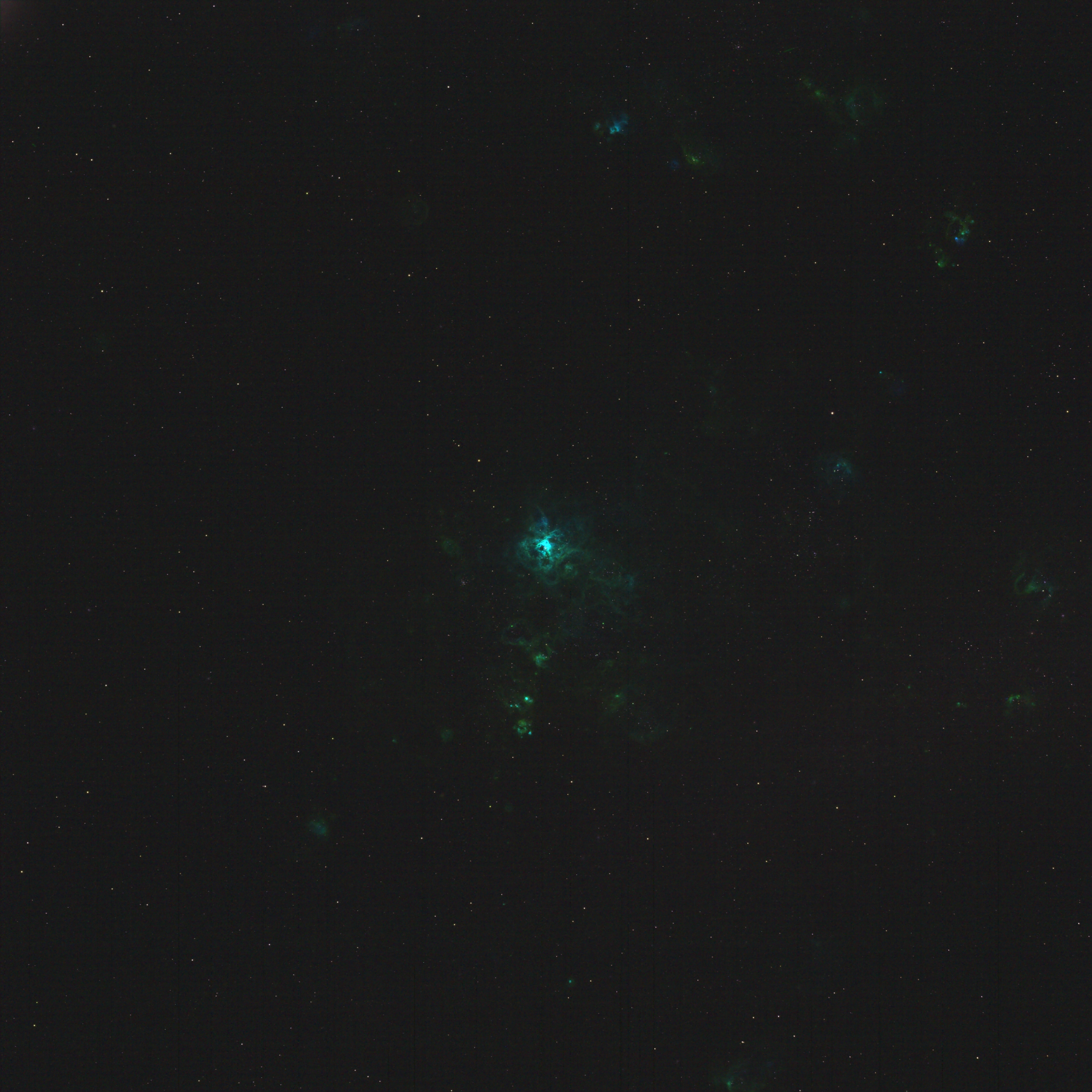
Located in the Large Magellanic Cloud, this is the largest and most luminous HII region in the Local Group. Were it as close as the Orion Nebula, it would cast shadows on Earth. The central cluster R136 contains some of the most massive stars known. Only visible from the southern hemisphere.
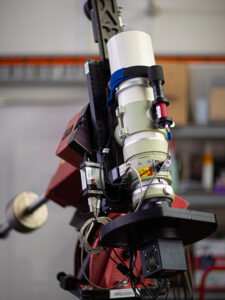 iTelescope T8iTelescope Takahashi FSQ EDSiding Spring Observatory, Australia (Q62) · Takahashi FSQ-ED Petzval apo astrograph · Aperture 106mm · Focal length 530mm · f/5 · Camera FLI Microline…View equipment →OIIIDoubly-ionised oxygen at 496/501nm. Teal emission from planetary nebulae and supernova remnants.iTelescope T8iTelescope Takahashi FSQ EDSiding Spring Observatory, Australia (Q62) · Takahashi FSQ-ED Petzval apo astrograph · Aperture 106mm · Focal length 530mm · f/5 · Camera FLI Microline…View equipment →SIISingly-ionised sulphur at 672nm. Deep red emission, often the third channel in the Hubble (SHO) palette.iTelescope T8iTelescope Takahashi FSQ EDSiding Spring Observatory, Australia (Q62) · Takahashi FSQ-ED Petzval apo astrograph · Aperture 106mm · Focal length 530mm · f/5 · Camera FLI Microline…View equipment →
Comments