Helix Nebula
RA 22h 29m · Dec -20° 57′
5′

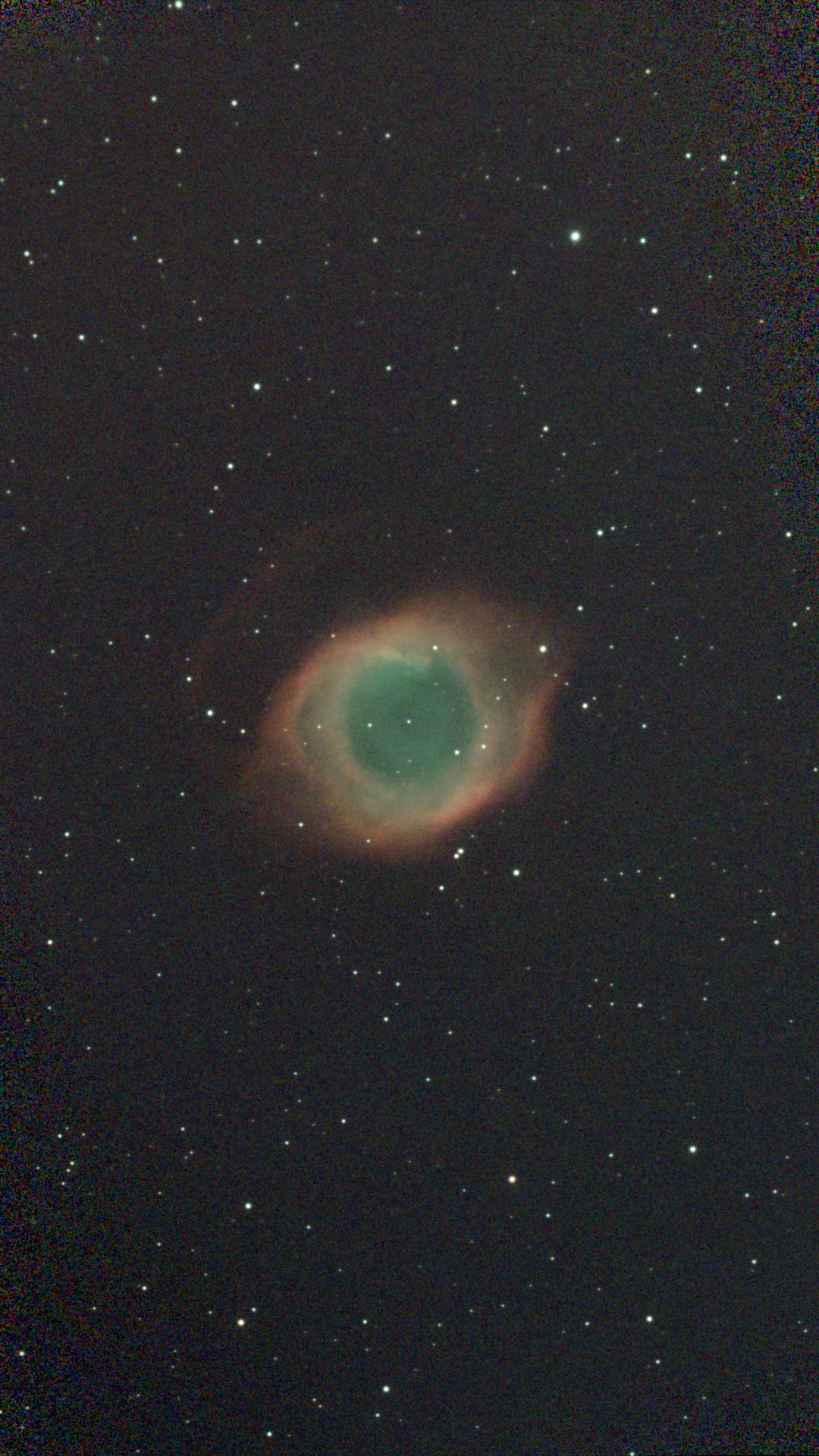
The nearest planetary nebula to Earth, spanning roughly half a degree — larger than the full Moon. Its proximity reveals extraordinary structural detail: cometary knots of condensed material point radially outward from the central star, each with a bright head and a long tail. A mosaic is needed to capture the full extent at longer focal lengths.

Planetary nebula

Helix Nebula

C 63 · Aquarius
These photons are ~655 years old
⧉ 5 versions of this capture — pick one to see its image and log
↻ Revisited — built over 2 nights, the next night
  1. 1 21/09/2025 1h 45m (316 × 20s) ZWO Seestar S50, ZWO Seestar S50 Camera
  2. 2 22/09/2025 128m (383 x 20s) ZWO Seestar S50, ZWO Seestar S50 Camera
21/09/2025 22/09/2025 The next night
Date
21/09/2025
Location
36.3859° N, 28.0412° E
Integration
1h 45m (316 × 20s)
Software
ZWO Seestar app
Notes
·
Total effort
10h 17m over 2 nights
Moon
🌘Waning crescent, 1% lit
Plate solve
Centre RA
22h 29m 19.1s
Centre Dec
−20° 56′ 31″
Field
42.8′ × 76.0′
Pixel scale
2.38″/px
Orientation
-177.4° E of N
Hemisphere
Southern
Also in this frame

Catalogued objects inside the plate-solved field, nearest the centre first. Highlighted names have their own photo here.

Where to find it

Finder chart
-21°30′-21°20′-21°10′-21°-20°50′-20°40′-20°30′-20°20′22h28m22h29m22h29m22h30m22h31mNGC 7293NE42.8′ x 76.0′5′

Star field and catalogued objects inside the plate-solved field, oriented to the solve. Fully offline, from the bundled star and deep-sky catalogues.

Interactive sky chart centred on 22 29 19.1 -20 56 31. Drag to pan, scroll to zoom, click a star or object to identify it. Zoom in to the plate-solved field for the DSS survey photo; zoom out for constellation figures and neighbouring catalogue objects. Fully self-hosted: the star and deep-sky catalogues and the survey image are all served from this site, so nothing external loads. Imagery: DSS2 colour (STScI / POSS-II). Constellation figures © Dominic Ford (GPLv3).
Captured from · Ρόδος (Rhodes)
36.3859° N, 28.0412° E · view on OpenStreetMap ↗ · Place data © GeoNames (CC BY)

Frequently asked questions

What kind of object is C 63?
C 63 is a planetary nebula.
Which constellation is C 63 in?
C 63 lies in the constellation Aquarius.
How far away is C 63?
The light in this image left C 63 roughly ~655 years ago, so that is how far back in time you are seeing it.
What are the coordinates of C 63?
C 63 sits at right ascension 22h 29m 19s and declination −20° 56′ 31″ (J2000).
When is the best time to photograph C 63?
C 63 rides highest in the evening sky around August, reaching about 33° above the horizon from around 36°N.
What equipment was used to photograph C 63?
This image of C 63 was captured with ZWO Seestar S50 and ZWO Seestar S50 Camera.
How much exposure time went into this image?
This image of C 63 represents 1h 45m (316 × 20s) + 128m (383 x 20s) of total integration time.

Comments

Leave a comment

Your email is never shown. Comments are held for moderation before they appear.