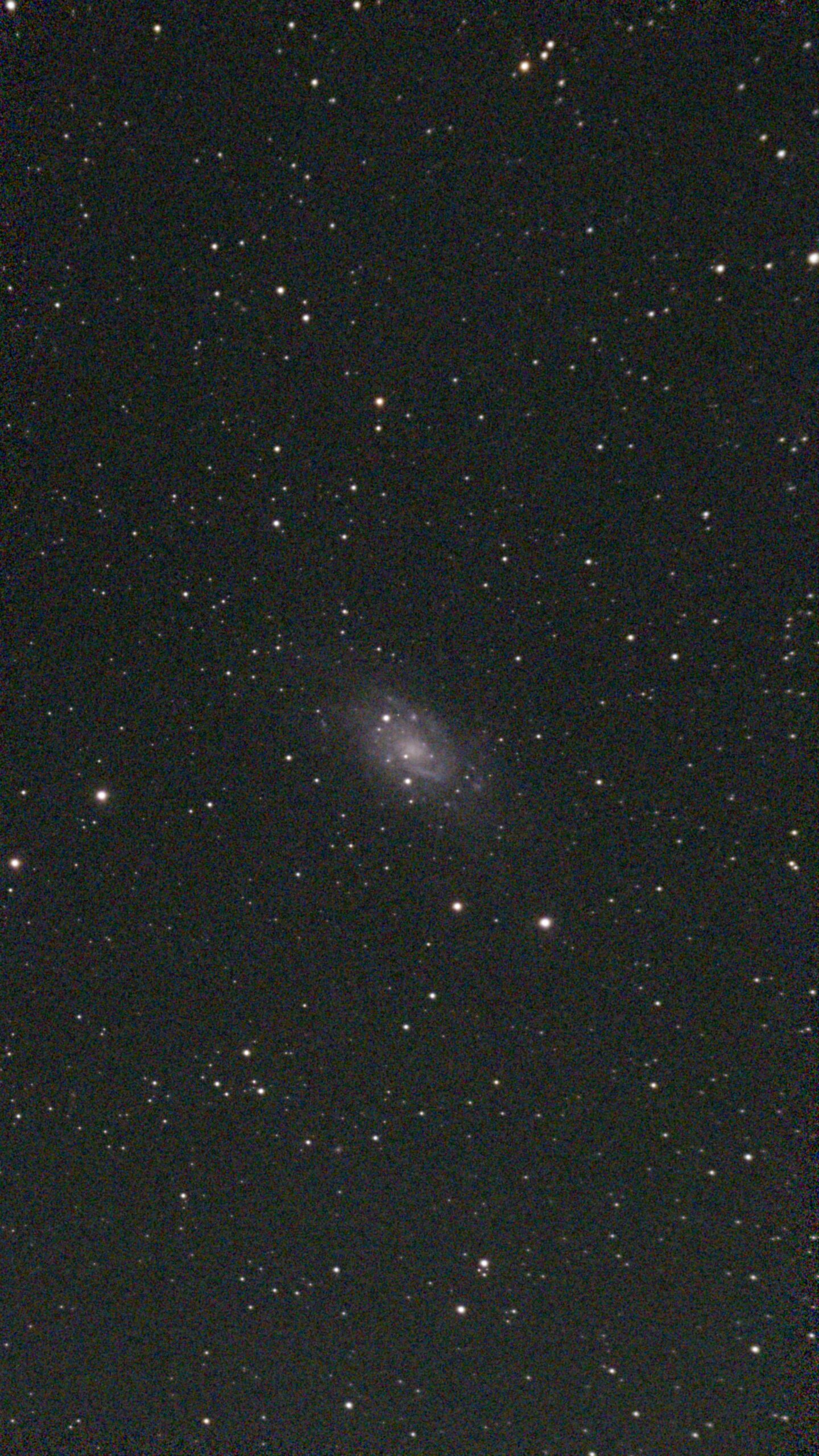
A bright, resolved spiral in the M81 group, one of the nearest galaxies. Numerous HII regions are visible in the arms, and the galaxy is well-placed from northern latitudes year-round.
Raw Seestar sub-frames demosaiced from the GRBG Bayer mosaic, aligned on the green channel (which a colour sensor samples at twice the density of red or blue) and combined with a sigma-clipped mean. One standard midtone stretch and nothing else: no gradient removal, no colour balance, no noise reduction. The honest baseline that shows exactly what the raw integration holds before any interpretation.
The stacked master given conventional processing: the sky gradient removed by a plane fitted outside the target, the red, green and blue backgrounds neutralised to a common level, saturation lifted, and noise reduction applied. Representative of a normal edit.
Everything the measurements justify and nothing they do not. The background fit is constrained so it cannot subtract the nebula itself; the deepest channel is sharpened with star-protected deconvolution; a second tone curve recovers the bright core without clipping the faint outer structure; and noise reduction is kept away from compact sources. Plate-solved against Gaia DR3, so scale and orientation are measured rather than assumed.
The Science Based Adjustments image cropped to the target at full resolution and framed on the nebula's core. The same processing as that version; only the field of view differs.
Comments