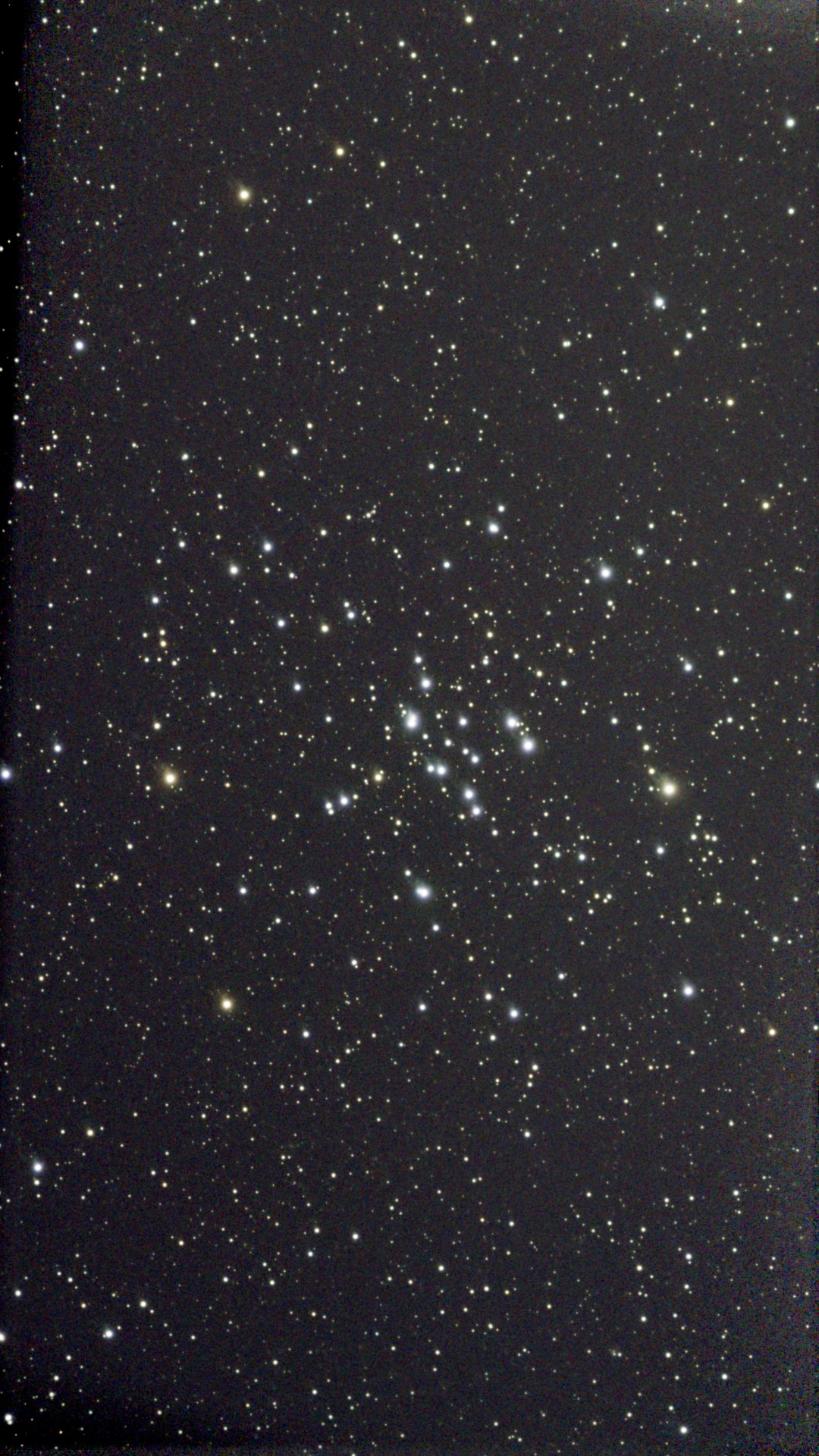
NGC 1039 Open Cluster
RA 2h 43m · Dec +42° 47′
5′

A loose, bright open cluster of around 100 stars, most of which are blue-white B-type. Easy wide-field target, best framed against the Perseus Milky Way.

Open cluster

NGC 1039 Open Cluster

M 34 · Perseus
These photons are ~1,400 years old
⧉ 5 versions of this capture — pick one to see its image and log
↻ Revisited — built over 2 nights, the next night
  1. 1 24/09/2025 31m (184 × 10s) ZWO Seestar S50, ZWO Seestar S50 Camera
  2. 2 25/09/2025 30m (180 x 10s) ZWO Seestar S50, ZWO Seestar S50 Camera
24/09/2025 25/09/2025 The next night
Date
24/09/2025
Location
36.3858° N, 28.0412° E
Integration
31m (184 × 10s)
Software
ZWO Seestar app
Notes
·
Total effort
2h 31m over 2 nights
Moon
🌒Waxing crescent, 5% lit
Plate solve
Centre RA
2h 42m 34.8s
Centre Dec
+42° 47′ 21″
Field
42.7′ × 76.0′
Pixel scale
2.37″/px
Orientation
74.6° E of N
Hemisphere
Northern
Also in this frame

Catalogued objects inside the plate-solved field, nearest the centre first. Highlighted names have their own photo here.

Where to find it

Finder chart
+42°20′+42°30′+42°40′+42°50′+43°+43°10′2h39m2h40m2h41m2h41m2h42m2h43m2h43m2h44m2h45m2h45m2h46mM 34NE42.7′ x 76.0′5′

Star field and catalogued objects inside the plate-solved field, oriented to the solve. Fully offline, from the bundled star and deep-sky catalogues.

Interactive sky chart centred on 2 42 34.8 +42 47 21. Drag to pan, scroll to zoom, click a star or object to identify it. Zoom in to the plate-solved field for the DSS survey photo; zoom out for constellation figures and neighbouring catalogue objects. Fully self-hosted: the star and deep-sky catalogues and the survey image are all served from this site, so nothing external loads. Imagery: DSS2 colour (STScI / POSS-II). Constellation figures © Dominic Ford (GPLv3).
Captured from · Ρόδος (Rhodes)
36.3858° N, 28.0412° E · view on OpenStreetMap ↗ · Place data © GeoNames (CC BY)

Frequently asked questions

What kind of object is M 34?
M 34 is an open cluster.
Which constellation is M 34 in?
M 34 lies in the constellation Perseus.
How far away is M 34?
The light in this image left M 34 roughly ~1,400 years ago, so that is how far back in time you are seeing it.
What are the coordinates of M 34?
M 34 sits at right ascension 02h 42m 35s and declination +42° 47′ 21″ (J2000).
When is the best time to photograph M 34?
M 34 rides highest in the evening sky around October, reaching about 84° above the horizon from around 36°N.
What equipment was used to photograph M 34?
This image of M 34 was captured with ZWO Seestar S50 and ZWO Seestar S50 Camera.
How much exposure time went into this image?
This image of M 34 represents 31m (184 × 10s) + 30m (180 x 10s) of total integration time.

Comments

Leave a comment

Your email is never shown. Comments are held for moderation before they appear.