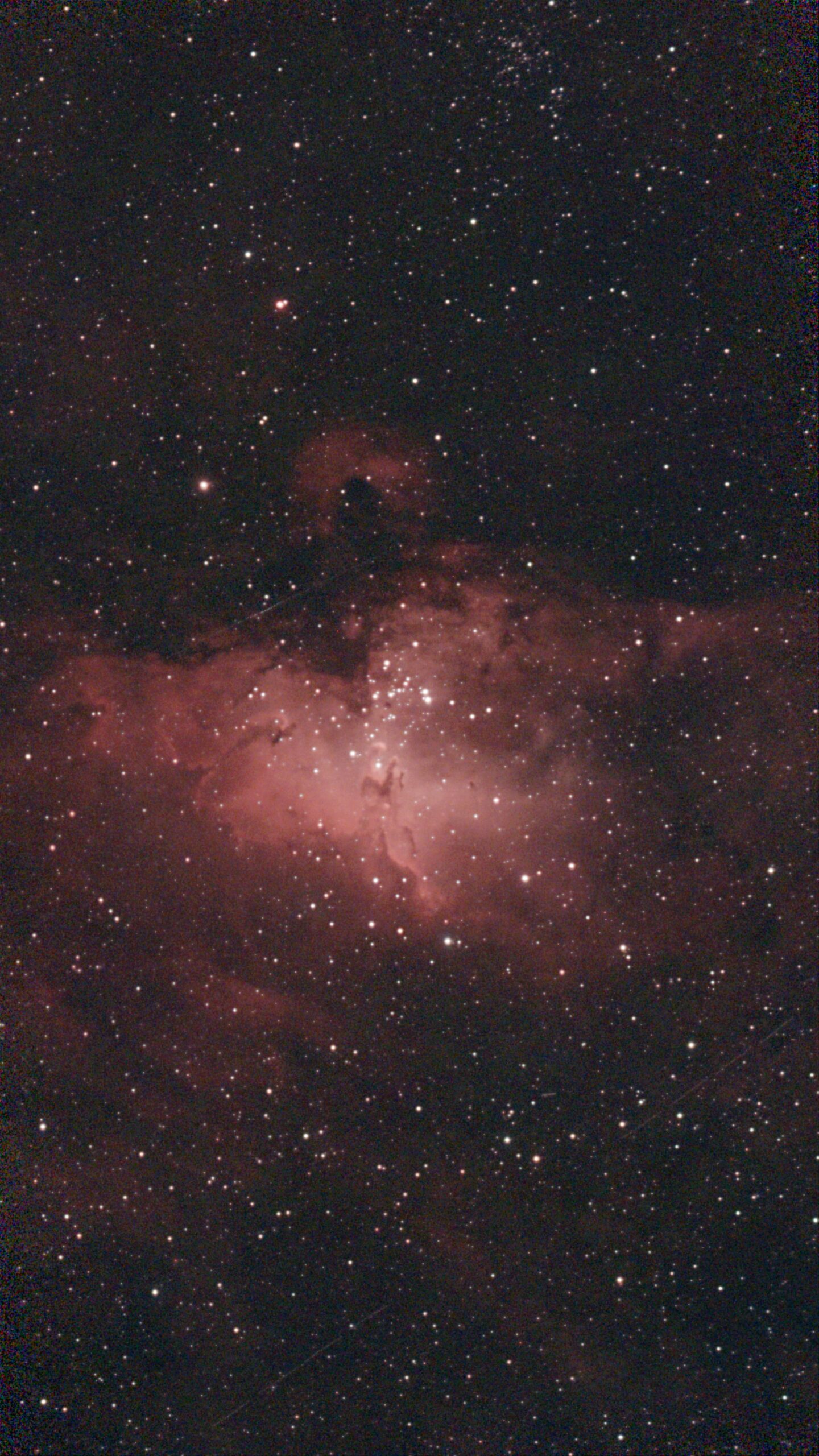
The site of the iconic “Pillars of Creation” — towering columns of gas and dust sculpted by radiation from the young star cluster at the centre. A superb narrowband target; Hα, SII, and OIII reveal extraordinary structure in the surrounding nebula.
Frequently asked questions
What kind of object is M 16?
M 16 is an emission nebula.
Which constellation is M 16 in?
M 16 lies in the constellation Serpens.
How far away is M 16?
The light in this image left M 16 roughly ~7,000 years ago, so that is how far back in time you are seeing it.
What are the coordinates of M 16?
M 16 sits at right ascension 18h 18m 38s and declination −13° 44′ 35″ (J2000).
When is the best time to photograph M 16?
M 16 rides highest in the evening sky around June, reaching about 23° above the horizon from around 54°N.
What equipment was used to photograph M 16?
This image of M 16 was captured with ZWO Seestar S50 and ZWO Seestar S50 Camera.
How much exposure time went into this image?
This image of M 16 represents 35m (211 × 10s) of total integration time.