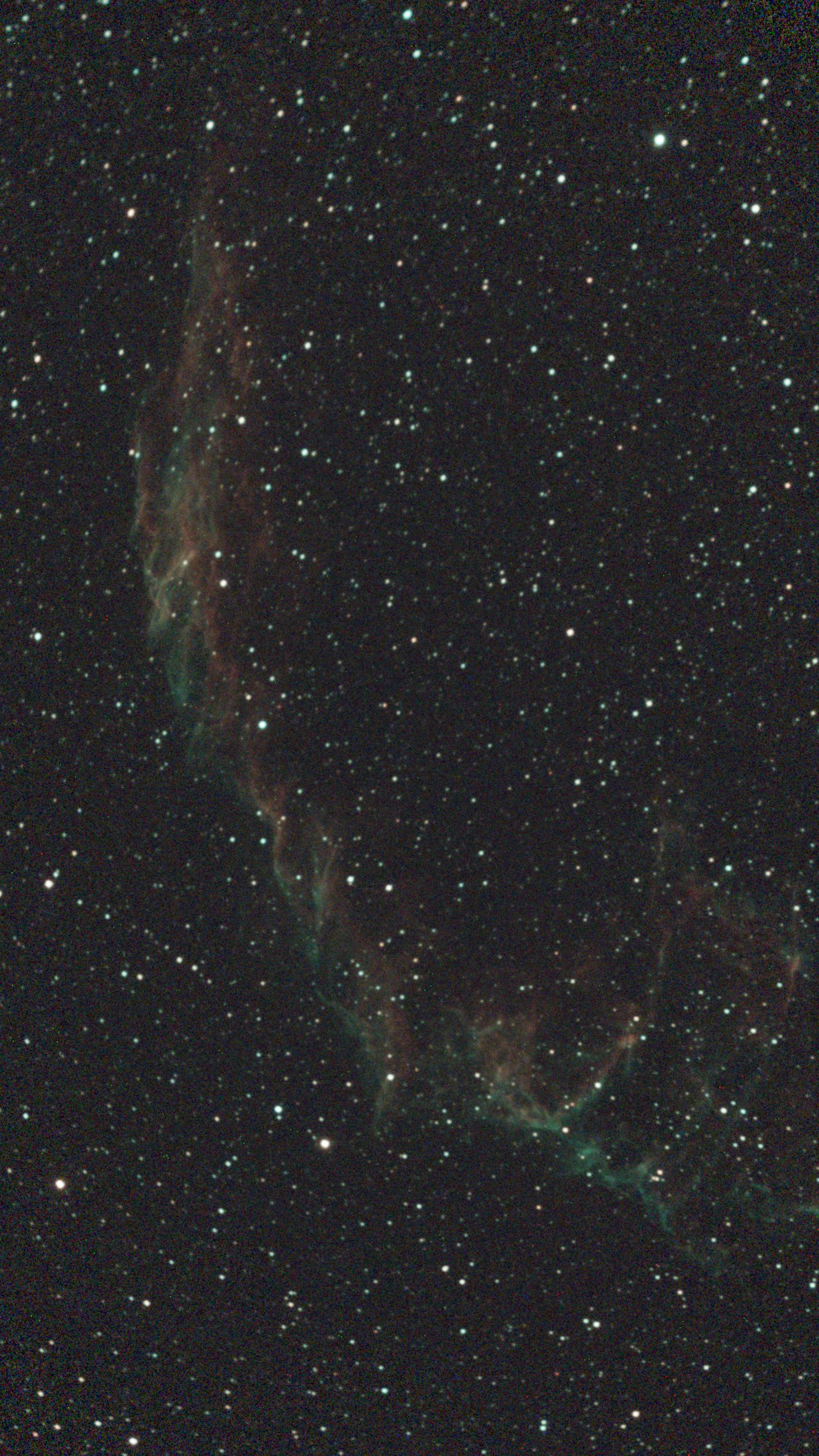
The brightest section of the Cygnus Loop supernova remnant — the shredded shell of a star that exploded roughly 10–20,000 years ago. The delicate lacework of ionised filaments is one of the finest narrowband targets in the sky. Together with C34 (Western Veil) and Pickering’s Triangle, it forms the complete Veil complex.
Catalogued objects inside the plate-solved field, nearest the centre first. Highlighted names have their own photo here.
Star field and catalogued objects inside the plate-solved field, oriented to the solve. Fully offline, from the bundled star and deep-sky catalogues.
Interactive sky chart centred on 20 57 37.2 +31 23 03. Drag to pan, scroll to zoom, click a star or object to identify it. Zoom in to the plate-solved field for the DSS survey photo; zoom out for constellation figures and neighbouring catalogue objects. Fully self-hosted: the star and deep-sky catalogues and the survey image are all served from this site, so nothing external loads. Imagery: DSS2 colour (STScI / POSS-II). Constellation figures © Dominic Ford (GPLv3).
Comments