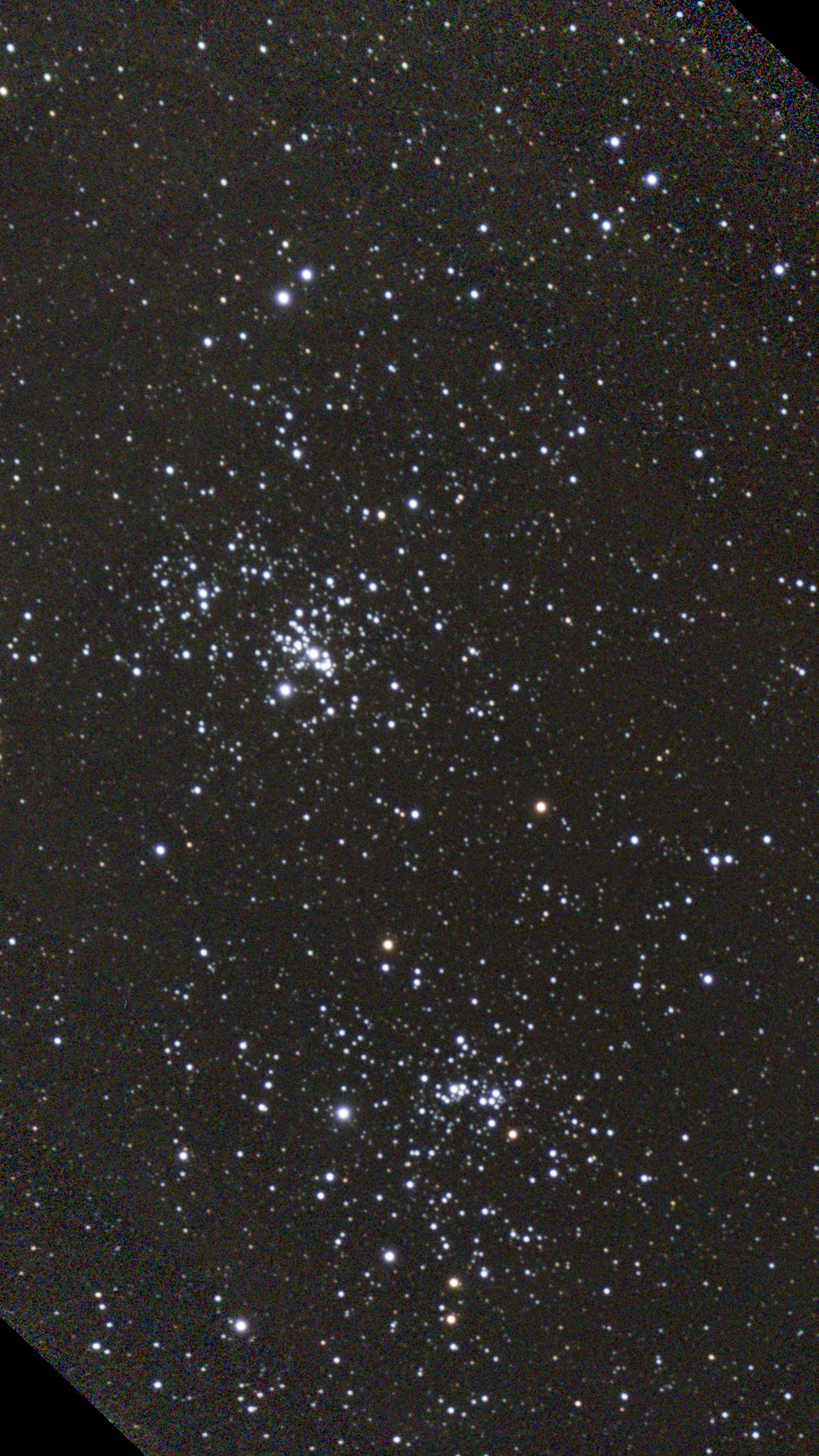
Two physically associated open clusters separated by only a few hundred light-years and presenting as a spectacular naked-eye pair. Embedded in the Perseus OB1 association; a sweeping wide-field image captures both clusters and the surrounding rich Milky Way and nebulosity.
Catalogued objects inside the plate-solved field, nearest the centre first. Highlighted names have their own photo here.
Star field and catalogued objects inside the plate-solved field, oriented to the solve. Fully offline, from the bundled star and deep-sky catalogues.
Interactive sky chart centred on 2 19 40.5 +57 11 22. Drag to pan, scroll to zoom, click a star or object to identify it. Zoom in to the plate-solved field for the DSS survey photo; zoom out for constellation figures and neighbouring catalogue objects. Fully self-hosted: the star and deep-sky catalogues and the survey image are all served from this site, so nothing external loads. Imagery: DSS2 colour (STScI / POSS-II). Constellation figures © Dominic Ford (GPLv3).
Comments